
The thinking behind it
The thinking behind it, in plain words.
Palante is a morning and evening practice. Here is what each part asks of you, what research suggests about ideas like it, and where the evidence is thin. We would rather be accurate than impressive.
A plain note first
Palante is a daily practice. It is not medical care, therapy or a crisis service, and nothing on this page is a promise of results. Studies describe groups of people, not you, and what helps one person may do little for another.
Morning and evening
The daily practice
Two short practices, one for the start of the day and one for the end. Each step is simple on purpose.
Gratitude
- In Palante
- The first step of the morning practice asks for three things you are grateful for.
- What research suggests
- In a well-known set of studies, people who regularly wrote down what they were grateful for reported more positive feelings than people in comparison groups. The effects were not the same on every measure, and gratitude does not fix a hard day. It is a small, repeatable way to notice what is already good.
Truths in your own words
- In Palante
- Step two asks for three truths about your highest self. You write them yourself.
- What research suggests
- Research on positive self-statements is mixed. In one set of experiments, repeating a positive statement helped some people feel better and made others feel worse, particularly people who already felt low about themselves. Palante asks you to write the truths in your own words, which may feel more natural than repeating a slogan.
One word for the day
- In Palante
- Step three is a one-word intention, such as Presence.
- What research suggests
- Research on planning ahead suggests that deciding in advance how you want to act tends to help people follow through. A single word is much simpler than the if-then plans in those studies, so think of it as a small anchor for your attention, not a proven technique.
Evening reflection
- In Palante
- From 6 pm, the evening practice offers four prompts: what you are grateful for, what you learned, what you accomplished and what delighted you.
- What research suggests
- A meta-analysis of 146 randomized studies of expressive writing found a small positive effect on average, with results that vary from person to person. Most of those studies asked people to write about stressful or emotional events, which is different from Palante’s prompts, and Palante’s prompts have not been tested in them. We offer the evening practice as a way to close the day, nothing more.
Slowing down
Breath and stillness
Two ways to pause that sit under Explore. Both are old practices with a growing, and still uneven, body of research.
Slow breathing
- In Palante
- Breathwork offers three five-minute patterns: Focus (box breathing, 4-4-4-4), Relax (4-7-8) and Balance (even 6-6 breathing).
- What research suggests
- A systematic review of 15 studies in healthy adults found that slow breathing, fewer than ten breaths a minute, was associated with higher heart rate variability, often read as a sign of parasympathetic activity, along with changes in brain activity and in how people reported feeling. The authors note that how it works is still debated. The review did not test these specific patterns, and Palante does not claim they have the same effect.
Meditation
- In Palante
- The meditation timer runs from 5 to 60 minutes, with an optional intention, five mantras, atmosphere presets and a gong at the end.
- What research suggests
- A review of 47 randomized trials found small to moderate benefits from meditation programs on some measures, such as symptoms of anxiety and depression, and weaker evidence on others, including stress. It did not find meditation to be better than other active treatments. Palante’s timer is a place to sit, not a treatment.
Sound and quiet
Atmosphere, not treatment
Sound and a quiet place to look can shape how a room feels. We make no claim beyond that.
Sound as atmosphere
- In Palante
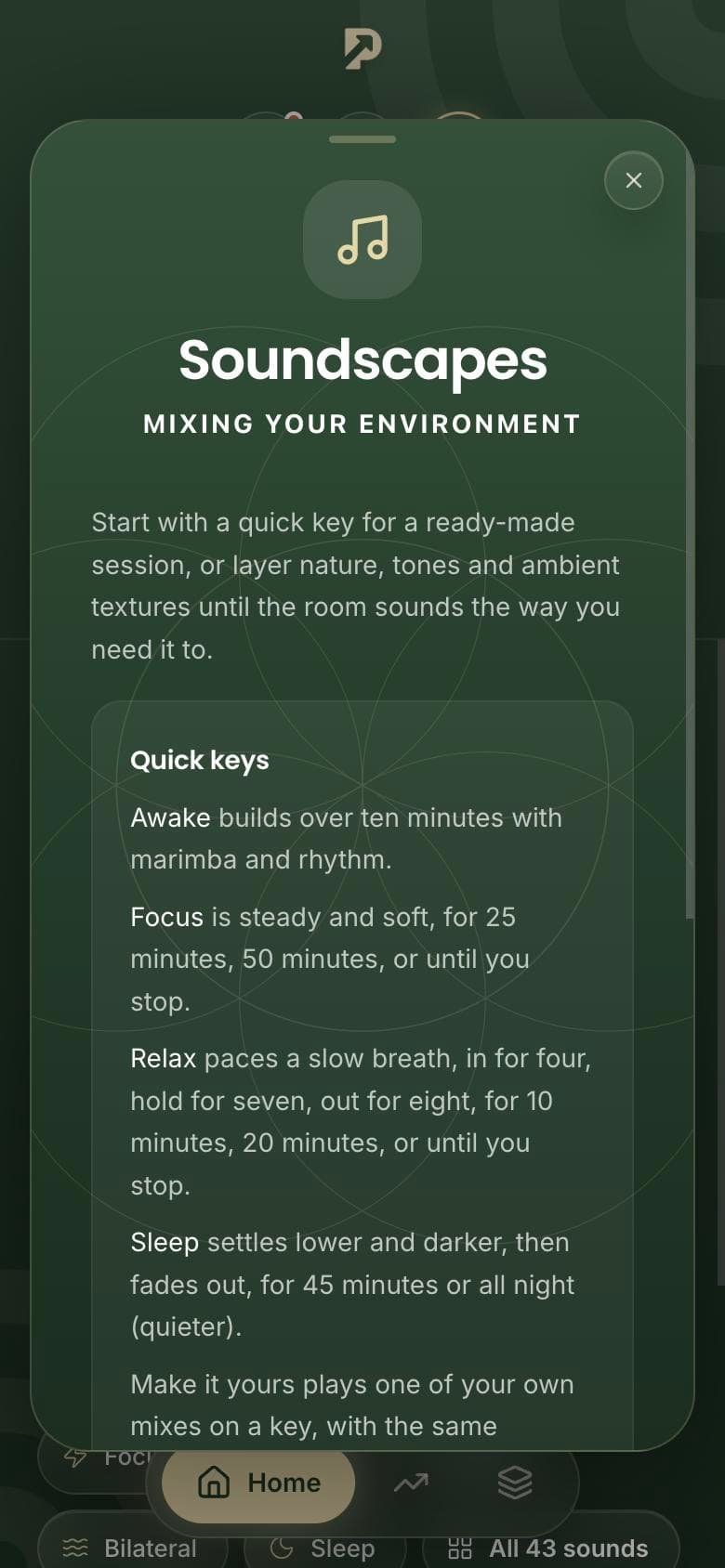
- Soundscapes has 43 sounds in eight categories, four quick keys (Awake, Focus, Relax and Sleep) and room for up to eight mixes of your own.
- What research suggests
- Some people find that steady, familiar sound makes a space feel calmer or less interrupted. Research on specific effects is mixed, including for binaural tones, so we do not promise any outcome. In the app we call it atmosphere, not treatment.
A restful pause
- In Palante
- The Koi Pond grows as you practice, and the koi that visit are a quiet thing to watch. You can turn the visits off in Settings.
- What research suggests
- Attention Restoration Theory proposes that gentle, undemanding things to look at can let tired attention recover. A systematic review of 31 studies found mixed support, with some attention measures improving after time in natural settings and others not. A pond on a phone is not a natural setting, so we offer it as a pause, not as a proven effect.
Showing up
Keeping going
Small and consistent
- In Palante
- Palante counts your practices and your streak, and the Mandala of Growth blooms across 90 practices. If you miss a day, it asks whether it was a rest day. Answer yes and your streak carries on.
- What research suggests
- A study that followed 96 people building a daily habit over 12 weeks found that missing a single day did not materially change how the habit formed. People in that study took anywhere from 18 to 254 days to reach a habit that felt automatic, so there is no magic number, and we do not claim one.
Not perfectly, but consistently.
Limits
What this page does not claim
- Palante is a daily practice. It is not medical care, therapy or a crisis service.
- Research describes groups of people. Your own results may be different, and that is fine.
- Sound, including binaural tones, is atmosphere. It is not a treatment.
- The studies here are a small selection, summarized in plain words. The sources below are the place to read what they actually found.
- If you are struggling, you deserve more than an app. In the US, you can contact 988 or text HOME to 741741. Elsewhere, findahelpline.com (opens in a new tab) can help you find a service near you.
Read for yourself
Sources
- Emmons, R. A., and McCullough, M. E. (2003). Counting blessings versus burdens. Journal of Personality and Social Psychology, 84, 377-389.View the study (opens in a new tab)
- Frattaroli, J. (2006). Experimental disclosure and its moderators: a meta-analysis. Psychological Bulletin, 132(6), 823-865.View the study (opens in a new tab)
- Gollwitzer, P. M., and Sheeran, P. (2006). Implementation intentions and goal achievement: a meta-analysis of effects and processes. Advances in Experimental Social Psychology, 38, 69-119.View the study (opens in a new tab)
- Goyal, M., and colleagues (2014). Meditation programs for psychological stress and well-being: a systematic review and meta-analysis. JAMA Internal Medicine, 174(3), 357-368.View the study (opens in a new tab)
- Lally, P., van Jaarsveld, C. H. M., Potts, H. W. W., and Wardle, J. (2010). How are habits formed: modelling habit formation in the real world. European Journal of Social Psychology, 40(6), 998-1009.View the study (opens in a new tab)
- Ohly, H., and colleagues (2016). Attention Restoration Theory: a systematic review of the attention restoration potential of exposure to natural environments. Journal of Toxicology and Environmental Health, Part B, 19(7), 305-343.View the study (opens in a new tab)
- Wood, J. V., Perunovic, W. Q. E., and Lee, J. W. (2009). Positive self-statements: power for some, peril for others. Psychological Science, 20, 860-866.View the study (opens in a new tab)
- Zaccaro, A., and colleagues (2018). How breath-control can change your life: a systematic review on psycho-physiological correlates of slow breathing. Frontiers in Human Neuroscience, 12, 353.View the study (opens in a new tab)
Start small. Keep going.
Palante is in beta on TestFlight. Join the beta to try it on your iPhone.